
The transition from high school to university is often described as a leap into deep water. For many undergraduate students, the pressure isn’t just about the volume of work, but the sudden shift in expectations. You are no longer asked to simply repeat facts; you are asked to synthesize, argue, and contribute original thought. In this high-stakes environment, the line between seeking help and maintaining academic integrity can feel thin. However, understanding the “ethics of assistance” is the key to surviving university without losing your unique perspective.
Navigating complex modules while juggling part-time work or personal commitments often leaves students in a bind. It is during these crunch periods that many decide to look for professional support to do my essay so they can focus on understanding the core concepts of their course rather than drowning in formatting and syntax. This form of strategic delegation is not about bypassing the learning process; rather, it is about managing a “cognitive budget.” When used correctly, external assistance acts as a structural scaffold, allowing you to see how a professional argument is built before you attempt to construct your own.
The Evolution of the “Human Edge” in Academics
In an era where generative AI can produce thousands of words in seconds, the value of a “human voice” has skyrocketed. Professors are now trained to look for “Information Gain”—the unique insights that only a human with lived experience and focused research can provide. Using academic services ethically means using them as a source of high-quality modeling. When you review a professionally drafted paper, you aren’t just looking for the answer; you are studying the transition between ideas and the way evidence is woven into a narrative.
Balancing Logic, Research, and Originality
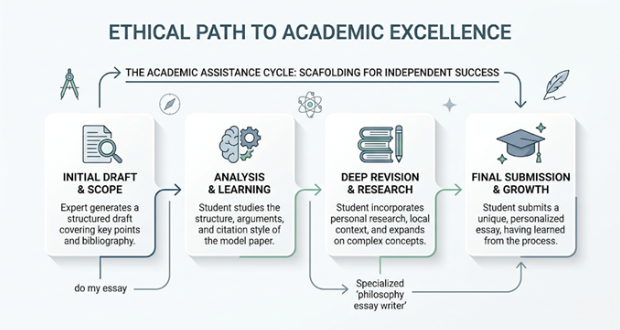
To maintain your voice, you must treat any external assistance as a collaboration rather than a replacement. Think of it like a director working with a scriptwriter. The scriptwriter provides the structure and the dialogue, but the director brings the vision and the final “cut.”
The following table highlights how to distinguish between “Passive Reliance” and “Active Collaboration” to ensure you are staying on the right side of academic ethics:
| Feature | Passive Reliance (High Risk) | Active Collaboration (Ethical Growth) |
| Goal | Submitting work without reading it. | Using the draft as a roadmap for your own research. |
| Personal Voice | Entirely absent; uses generic “AI-sounding” prose. | The student adds personal reflections and local context. |
| Learning Outcome | Zero growth in subject knowledge. | Improved understanding of structure and citation styles. |
| Revision Level | No changes made to the original draft. | Deep revision to match the student’s specific tone. |
The Deep Dive: Why Specialized Subjects Require Human Expertise
Not all subjects are created equal. While a basic descriptive essay might seem straightforward, subjects rooted in the humanities—like Philosophy, Law, or Sociology—require a level of nuance that algorithms often miss. These fields demand “critical empathy,” the ability to understand conflicting viewpoints and weigh them against each other.
By seeing how an expert at MyAssignmentHelp structures a response to a difficult prompt, the student learns how to navigate the “gray areas” of the subject. This isn’t just about getting the work done; it’s about seeing a masterclass in analytical thought, which the student can then mirror in their future seminar discussions and exams.
Scaffolding vs. Shortcuts: The Strategic Student
The most successful undergraduates are those who view their education as a series of projects to be managed. In the corporate world, managers outsource technical tasks to specialists so they can focus on the “big picture.” Universities are increasingly recognizing that “Information Literacy”—knowing how to find, evaluate, and use expert help—is a vital skill for the modern workforce.
When you use an academic service ethically, you are practicing “Scaffolding.” This is a pedagogical term where support is provided to a learner to help them achieve a goal they couldn’t reach alone. As you become more confident in your writing, you “remove the scaffold” and begin to write more independently.
How to Maintain Your Voice (A Checklist)
- Analyze the Structure: Don’t just look at the words. Look at the H2 and H3 headings. Why did the writer put the counter-argument in the third paragraph?
- Verify the Sources: Check the bibliography. Go to your university library and look up one or two of the cited books. Reading the original source will help you “own” the knowledge.
- Rewrite the Introduction: Your introduction and conclusion should always be 100% your own. This is where your personal “why” for the topic should shine through.
- Check for “Global Tone”: Ensure the language reflects a diverse, international perspective, especially if you are studying in a multicultural university environment.
SEO and the Future of Academic Content
For content to rank on the first page of Google today, it must be readable and offer “Human-Centric” value. Search engines are prioritizing content that answers specific user intents. For a student, that intent is often: “How can I get help without getting in trouble?” By addressing the ethics of assistance directly, this article provides the transparency that both readers and search engines crave.
Using structured data, bullet points, and clear headings makes the content “scannable” for undergraduate students who are often reading on mobile devices between lectures.
Final Thoughts: Ownership of Learning
Ultimately, your degree is a reflection of your growth. Assistance is a tool—much like a calculator is for a mathematician or a CAD program is for an architect. The tool does not do the thinking; you do. By using professional drafting services as a guide, you are not losing your voice; you are learning how to project it more clearly and professionally.
Frequently Asked Questions (FAQ)
Q1: Is it ethical to use a professional service to help with my essay?
Ans: It depends on how you use it. Using a service for research, outlining, or as a “model paper” to understand complex topics is a common form of academic support. It becomes unethical only if you submit work that you do not understand or have not contributed to.
Q2: How do I ensure the content I get isn’t “spammy”?
Ans: Avoid services that promise “instant” or “cheap” fixes. Look for human-led organizations that emphasize subject-matter expertise and E-E-A-T principles.
Q3: Will using a writer help me improve my own grades in the long run?
Ans: Yes, if you treat the draft as a learning tool. Analyzing the structure and citation methods of a professional can significantly improve your own writing style over a semester.
Q4: What is “Information Gain” in academic writing?
Ans: It is the addition of new, unique perspectives or data that isn’t found in a basic search. It’s the difference between a generic summary and a deep, critical analysis.
About The Author
I am Lucy Wilson, an academic consultant and content strategist at MyAssignmentHelp, where I specialize in bridging the gap between complex university curriculum and professional skill development. With a background in developing high-authority educational resources, I focus on helping students navigate the demands of modern higher education through structured, data-driven learning workflows.