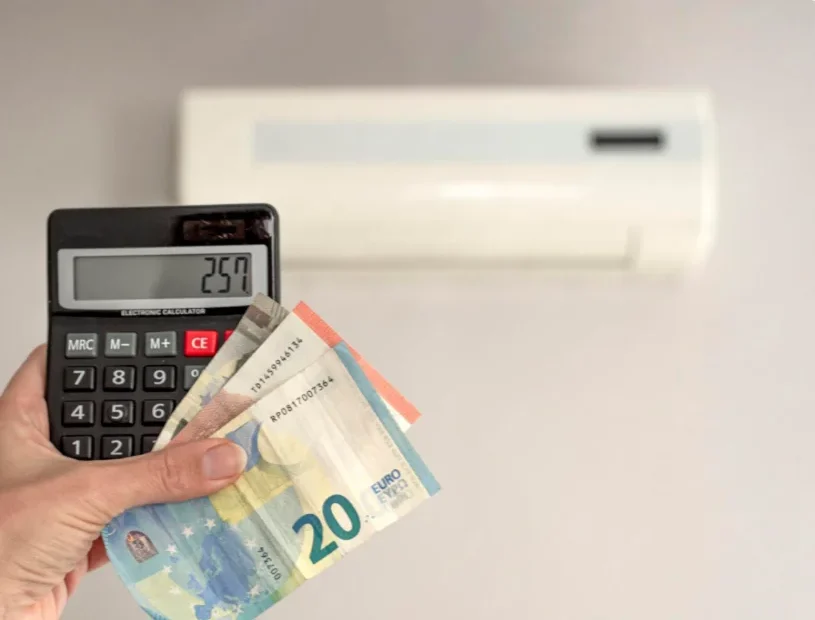
Your electricity bill just jumped again, and nothing obvious changed. You didn’t run more lights. You didn’t buy a new appliance. But somehow, the number keeps creeping up every month through summer. Nine times out of ten, the culprit is the AC unit humming away in the background, doing its job just badly enough that you don’t notice until the damage shows up on your statement.
The frustrating part is that a struggling air conditioner rarely announces itself with a dramatic breakdown. It just quietly gets worse, working harder, pulling more power, and shortening its own life while you assume everything is fine. Catching these signs early is the difference between a simple tune-up and a full system replacement.
Florida Homes Carry an Unusually Heavy AC Burden
Before getting into the warning signs, it’s worth understanding why this matters more in a hot, humid climate than almost anywhere else. In Florida, 96% of households use air conditioning, with 90% using a central air-conditioning unit, according to the U.S. Energy Information Administration’s 2020 Residential Energy Consumption Survey (U.S. EIA, 2022). That near-universal reliance means your system runs longer, cycles more often, and faces far greater wear than a comparable unit in, say, Seattle. An AC that’s slightly off its game in Wisconsin might cost you a few extra dollars. In Florida, that same inefficiency runs for ten or eleven months a year, and the financial hit is compounding the entire time.
The good news is that most efficiency losses are detectable well before they become catastrophic. You just need to know what to look for.
Sign 1: Your Energy Bills Are Rising Without a Clear Reason
This is the most common signal and the easiest to dismiss. Bills go up, you assume it’s the utility rate, and you move on. But a sustained upward trend during months when your habits haven’t changed is almost always your HVAC system losing efficiency.
Think about it this way: electricity consumption for air conditioning accounted for about 19% of electricity consumption in U.S. homes in 2020, making it one of the largest energy end uses in the country, according to the EIA’s Residential Energy Consumption Survey (U.S. EIA FAQ). In a state like Florida, where that system runs almost year-round, even a modest efficiency drop translates directly into dollars leaving your account every single month. Pull your last 12 months of bills and compare them to the same period from two years ago. If costs are up and usage habits are flat, the AC deserves a hard look.
Sign 2: The System Runs Almost Constantly
An air conditioner is supposed to cycle on, cool the space to your target temperature, and then cycle off. If yours runs nonstop for hours during a normal afternoon and the house still feels warm, the system is working far beyond its design intent.
Constant runtime usually points to one of three problems. The unit is undersized for the space. The refrigerant charge is low, meaning the system can’t transfer heat effectively. Or the airflow is restricted somewhere in the ductwork or at the air handler itself. All three of these issues cause the compressor to labor without producing equivalent cooling, which is exactly the combination that kills systems years ahead of schedule.
Here’s the scenario most Florida homeowners have lived through: it’s July, the thermostat is set to 75 degrees, and by 3 p.m. the house is sitting at 79 no matter how long the system runs. You open a vent to feel the airflow, and it barely moves. That weak airflow is the tell. Something upstream is restricting the system, and every hour it runs in that state accelerates wear on the compressor and blower motor alike.
Sign 3: A Clogged Filter Is Wasting Real Money
This one is almost embarrassingly simple, but it’s also the most common driver of preventable efficiency loss. A clogged filter can result in a 15% reduction in efficiency, according to the USDOE, as reported by the Los Angeles Department of Water and Power (LADWP, 2024). A 15% hit is not a rounding error. On a system that already accounts for a significant chunk of your monthly electricity cost, that’s real money disappearing through sheer neglect.
The filter’s job is to protect the internal components of the system from dust and debris. When it fills up, air can’t pass through freely. The blower motor strains, the evaporator coil gets starved of airflow, and the whole system works harder to move the same volume of conditioned air. In a dusty or pet-friendly household, filters can reach this point in four to six weeks. Check yours monthly and replace it before it looks visibly grey and packed. It takes two minutes, and it’s genuinely one of the highest-return maintenance tasks you can do.
Sign 4: Warm or Uneven Temperatures Between Rooms
Walk through your home on a hot afternoon. If the living room is comfortable but the back bedroom feels like a different climate, you have an airflow problem. Uneven cooling almost always traces back to duct leaks, a refrigerant issue, or a failing blower motor that can no longer push conditioned air to the far reaches of the house.
Homeowners often compensate by cranking the thermostat lower, which just makes the system run longer and harder to achieve acceptable temperatures in the problem rooms. That workaround costs money every single day and does nothing to fix the underlying cause. If your temperature map looks inconsistent room to room, a professional inspection is the right call, not a lower thermostat setting.
Sign 5: The Unit Is Over Ten Years Old and Has Never Been Serviced
Age alone doesn’t condemn an AC system. But age combined with zero maintenance history is a serious flag. A well-maintained central system can deliver reliable cooling for fifteen to twenty years. One that has been ignored tends to degrade significantly after a decade, with dirty coils, worn capacitors, and refrigerant that’s slowly leaked to a suboptimal charge level.
If you can’t remember the last time a technician looked at your system, and the unit is already past the ten-year mark, assume it’s running at a fraction of its rated efficiency. Scheduling professional AC service West Palm Beach before a small problem escalates into a compressor replacement is always the smarter financial move.
The CARE Check: A Simple Framework for Homeowners
Before calling anyone, do your own quick audit using the CARE Check. It takes about ten minutes and gives you a clear picture of what you’re dealing with.
- Coils: Peek at the outdoor condenser unit. Are the fins clean and open, or packed with debris, grass clippings, and dust? Restricted condenser coils are a top cause of reduced heat transfer.
- Airflow: Hold your hand near each supply vent in the house. Is airflow strong and consistent? Weak or absent airflow in certain rooms signals a duct or blower problem.
- Runtime: Time how long the system runs during a normal afternoon cycle. If it runs for more than 20 minutes continuously without reaching your set temperature, something is off.
- Energy bill: Compare last month’s bill to the same month one year ago. A rise of more than 10% with no change in habits warrants a professional review.
If two or more of those checks flag a problem, the system needs a professional eye. If all four are flagging issues at once, that conversation becomes urgent.
Acting Early Always Costs Less
The math on deferred AC maintenance is never favorable. A dirty coil cleaning costs a fraction of a compressor repair. A refrigerant top-up costs a fraction of a system replacement. Catching these five warning signs early and responding to them means your system runs closer to its rated efficiency, your bills stay predictable, and you get the full lifespan out of an expensive piece of equipment. The only thing worse than a high energy bill is a high energy bill followed by an emergency replacement in the middle of August.
“Systems that receive annual AC service operate more efficiently, use less energy, and experience fewer premature breakdowns.” – Widely documented finding across HVAC industry maintenance research and manufacturer guidance.
Your AC is probably working right now. The question is whether it’s working well, or just well enough to keep you from noticing how much it’s costing you.